Plaid Cymru’s Environmental Commitments: The Positives, the Questions, and the Concerns

Plaid Cymru’s Environmental Commitments: The Positives, the Questions, and the Concerns

Plaid Cymru’s manifesto sets out ambitious plans for nature recovery and environmental reform in Wales, but concerns remain over delivery and the protection of existing environmental safeguards.

Plaid Cymru’s manifesto sets out an ambitious vision for Wales’s environment, farming, and natural resources. There is much to welcome, particularly where the manifesto recognises the scale of the nature crisis and the need for stronger governance. However, as ever, the detail of delivery will determine whether these commitments genuinely protect and restore nature in Wales.

Below, we set out where we strongly welcome Plaid’s proposals, where we see potential but need greater clarity, and where we have real concerns that must be addressed.

The Positives

There are several areas where Plaid’s manifesto aligns strongly with what nature and people in Wales need.

Stronger Environmental Governance

The commitment to establish an independent Office for Environmental Governance Wales is hugely welcome. Since Brexit, Wales has lacked a dedicated body to hold public authorities to account for meeting environmental law and nature recovery targets. This new office must be genuinely independent, properly resourced, and empowered to challenge failure across government and public bodies — but the commitment itself is a vital and long‑overdue step.

Investing in Nature as a Public Good

Support for a National Nature Service for Wales sends an important signal that nature recovery is not just a cost but an opportunity. Restoring ecosystems can increase eco‑literacy, build green skills, and create secure jobs across Wales, particularly in rural and coastal communities where economic opportunities are often limited.

Putting the Environment at the Heart of Water Regulation

The proposal to establish a new Welsh water regulator with powers to cap excessive bonuses and prioritise investment in infrastructure is another welcome move. For too long, environmental impacts have been sidelined in water regulation. Directing investment towards reducing sewage spills, upgrading drainage systems, and delivering wider environmental improvements is essential — though it will require a new Water (Wales) Act to deliver.

LongTerm Stability for Farmers

Plaid’s commitment to a multi‑year funding cycle for the Sustainable Farming Scheme reflects the reality that nature‑friendly farming is a long‑term transition, not a one‑year project. Farmers need certainty and stability to make decisions that benefit soils, water, biodiversity, and food production.

Nature at Sea and Along the Coast

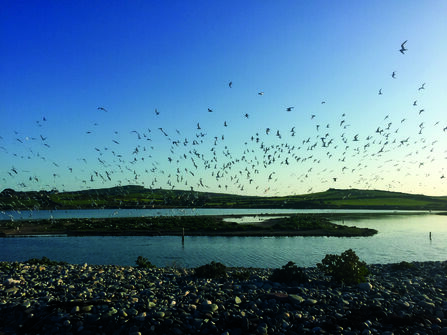
Support for a National Seagrass Plan, alongside efforts to grow Wales’s seaweed industry, is encouraging. Seagrass meadows are vital for biodiversity, carbon storage, and coastal protection, while a responsible seaweed sector could provide sustainable economic opportunities. Similarly, commitments to a seabird conservation strategy recognise Wales’s international importance for seabirds — species that are ecologically vital and central to nature‑based tourism in places like Skomer Island and Cemlyn Bay.
The Questions

Some commitments sit firmly in the “could be transformative if done well” category.

Climate and Nature Planning

An updated Climate and Nature Action Plan could be useful, but Wales does not need another plan that sits on a shelf. What matters now is clear delivery pathways, measurable outcomes, and accountability. Without this, even the best‑worded plan will fail to halt nature loss or reduce emissions at the pace required.

Embedding Environment Across Government

Making decarbonisation, sustainability, and environmental protection cabinet‑level, cross‑cutting responsibilities is a positive signal. However, this should already be happening under the Well‑being of Future Generations Act and the Environment (Wales) Act, and further strengthened by the recent Environment (Principles, Governance, and Biodiversity Targets) (Wales) Act. Crucially, nature recovery must be explicitly prioritised, so it is not diluted within broader sustainability agendas.

Spatial Planning and Land Use Reform

Reforming spatial planning and producing a new National Development Framework could be a powerful tool for shaping Wales’s future. But talk of finding the “right balance” between food security, renewable energy, development, and nature raises concerns. Any reform must strengthen — not undermine — existing environmental protections and must genuinely put nature recovery at its core.

The Concerns

There are also areas where we believe Plaid’s proposals risk weakening protections if not carefully reconsidered.

Streamlining Farm Regulation

We are not opposed to reducing unnecessary bureaucracy for family farms. However, streamlining must not come at the expense of environmental outcomes. Regulations exist for a reason, particularly when agriculture is the largest source of nutrient pollution in Welsh waterways. Cutting paperwork must not mean cutting protections for soils, rivers, and wildlife. Therefore, we are supportive of reviewing the process but remain steadfast that we cannot see a weakening of protections.

Managing Nitrate Pollution

Moving away from “farming by calendar” approaches makes sense in principle, but we are yet to see a credible alternative that would deliver the level of protection our waterways need. Regulations remain essential, and any new system must be robust, enforceable, and grounded in evidence.

Biosecurity and bTB

Maintaining strong biosecurity standards is critical, but it is concerning to frame wildlife as a primary driver of bTB when evidence shows that most transmission is cattle‑to‑cattle. Greater emphasis should be placed on vaccination, improved on‑farm biosecurity, and science‑led solutions that command public confidence.

Planning Reform and Permitted Development

Finally, proposals to reduce planning “complexity” and expand permitted development rights need urgent clarification. Streamlining processes must not be a backdoor to weakening environmental safeguards. If planning reform means removing nature protections, we would strongly oppose it.

Final Thoughts

Plaid Cymru’s manifesto shows welcome ambition on nature and the environment, and many proposals are steps in the right direction. But ambition must be matched with clarity, strong safeguards, and a clear commitment not to roll back hard‑won environmental protections. How these policies are implemented will matter just as much as the promises themselves.

Read our blogs